Hello, this is Fujiwara from Cyack Lab.
More than 90% of people working in the manufacturing industry have likely been involved in process improvement efforts at some point.
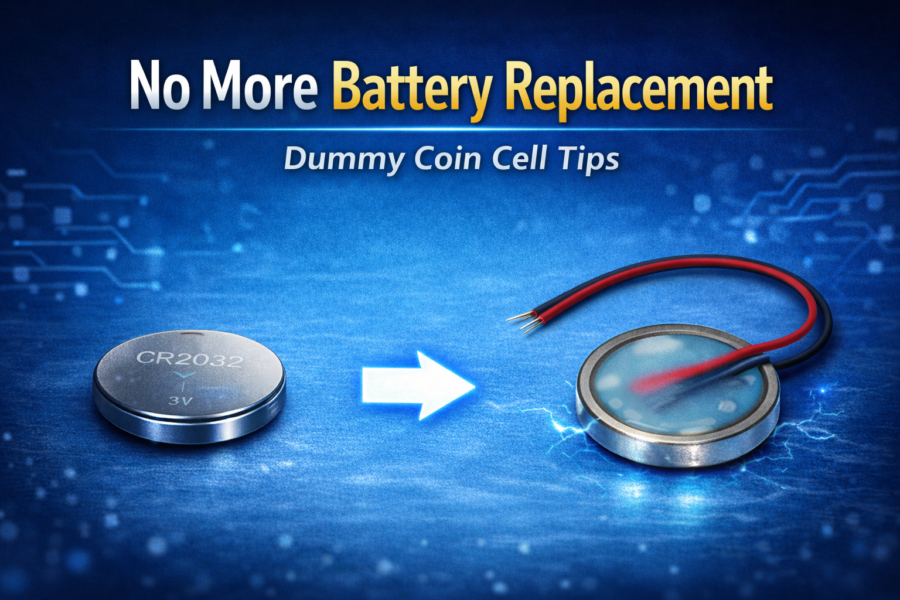
In this article, I would like to introduce a method for improving operations using dummy coin cell batteries, along with real-world examples.
If you find replacing coin cell batteries troublesome or are facing high labor costs for battery replacement, this article will provide valuable insights.
It may also offer useful ideas for those who are running out of improvement ideas, so I encourage you to read until the end.
Case Study: Company A — Significantly Increasing Coin Cell Battery Capacity
Problem
Production lines stop due to backup battery depletion.
Solution
A dummy coin cell battery was used, and a CR-type cylindrical lithium battery was adopted as the backup power source.
Compared to a CR2032, the battery capacity increased by approximately 7 times.
The first case study demonstrates a method for significantly increasing the capacity of coin cell batteries.
Have you ever wished that coin cell batteries had a larger capacity?
The nominal capacity of a CR2032 is 220 mAh, and even high-capacity versions are only around 240 mAh, making it difficult to achieve a substantial increase in capacity.
To address this, Company A used a dummy coin cell battery and replaced the CR2032 with a CR-type cylindrical lithium battery, significantly increasing the backup battery capacity.
By increasing the capacity of the backup battery, it is expected that the frequency of production line stoppages caused by battery depletion will be reduced.
For backup battery applications, we recommend the DB-R2032T dummy coin cell battery, which does not include a voltage regulator.
Since there is no power consumption from a regulator, it is particularly well-suited for backup power applications.
Case Study: Company B — Switching the Power Source from Coin Cell Batteries to an AC Adapter
Problem
IoT devices experience frequent battery depletion, resulting in higher-than-expected battery replacement costs.
Solution
A dummy coin cell battery was used to switch from coin cell operation to AC adapter power.
This eliminated battery replacement costs and reduced overall expenses.
The next case study demonstrates how battery replacement costs can be reduced.
Coin cell batteries are widely used in IoT devices due to their convenience and ease of use. However, in some cases, the cost of battery replacement can become higher than expected.
To address this, Company B used a dummy coin cell battery and switched the power supply to an AC adapter, eliminating the need for battery replacement.
While switching to a wired power source may reduce flexibility in device placement, the cost savings from eliminating battery replacement were significant. As a result, this improvement using a dummy coin cell battery was adopted.
Case Study: Company C — Reducing Inspection Workload with a Dummy Coin Cell Battery
Problem
In the inspection process, alligator clips were used to supply power to devices driven by coin cell batteries, but the connection process was time-consuming.
Solution
By using a dummy coin cell battery instead of alligator clips, devices can be connected to the power source without worrying about polarity or short circuits.
This significantly reduced the inspection workload.
The next case study demonstrates how inspection-related costs can be reduced.
Company C manufactures devices powered by coin cell batteries and faced challenges in supplying power during the final inspection process.
Power was supplied either by using actual coin cell batteries or by using alligator clips connected to a regulated power supply.
However, they experienced issues such as errors caused by battery depletion and incorrect connections. By introducing a dummy coin cell battery, these problems were successfully resolved.
Conclusion
In this article, we introduced several improvement methods using dummy coin cell batteries, along with real-world case studies.
We covered three types of improvements: increasing battery capacity, reducing battery replacement costs, and reducing inspection workload.
We hope these examples will help enhance your own process improvement efforts.
For more details about the dummy coin cell batteries used in these case studies, please refer to the product page below:
Learn more about the DB-R2032
You can purchase dummy coin cell batteries from our online store:
Cyack Lab Online Store
If you have any product requests or questions, please feel free to contact us using the inquiry form below.
We also support custom product development.
Contact us here