Relationship Between CR2032 Battery Life and Main Power-Off Time
Industrial PCs are commonly integrated into machine vision systems, measurement equipment, manufacturing equipment, and other industrial systems.
Once installed, such equipment is often used for 10 years or more.
Meanwhile, the motherboard inside an industrial PC may contain a small coin-cell battery that costs only a few dollars.
One of the most common examples is the CR2032.
This battery is primarily used to back up the RTC (Real-Time Clock) and CMOS, helping retain the system time and certain information even while the equipment’s main power is turned off.
There is one important characteristic of these RTC backup batteries that is easy to overlook:
The longer the equipment’s main power remains off, the longer the backup battery must operate.
The RTC Must Keep Running Even When the Equipment Is Powered Off
Even after a PC is powered off, the correct date and time are displayed the next time it starts up.
This is because the RTC is backed up independently of the main power supply.
While main power is available, the motherboard can supply power to the RTC. When the main power is lost, however, a backup battery such as a CR2032 keeps the RTC running.
In other words:
Main Power ON
→ The RTC is powered primarily by the system.
Main Power OFF
→ The RTC backup battery takes over.
It may seem natural to assume that the battery is not being consumed while the equipment is not in use. However, the opposite is true for the RTC backup battery: the longer the equipment remains unused with its main power turned off, the more the backup battery is consumed.
How Long Does an RTC Backup Battery Last?
The tricky part is that the lifespan of an RTC battery cannot simply be determined by saying, “It uses a CR2032, so it will last X years.”
Battery life depends on several factors, including:
- Backup current required by the RTC and CMOS circuitry
- Battery capacity
- Amount of time the main power is turned off
- Ambient temperature
- Self-discharge and aging of the battery itself
As a result, even when equipment uses the same type of 3 V primary lithium battery, the specified backup life can vary from one device to another.
In fact, looking at the specifications of industrial equipment manufacturers reveals some interesting differences.
Some Industrial Computers Offer 3 Years of Backup with Power Off and 10 Years with Power On
In the user manual for Advantech’s industrial computer ECU-4784, it is explained that the BR2032 battery used for CMOS backup is consumed while the system power is turned off.
The specified battery life is:
| Operating Condition | Battery Life |
|---|---|
| System Power OFF | Approx. 3 years |
| System Power ON | Approx. 10 years |
Even with the same equipment and the same backup battery, battery life can vary significantly depending on whether the system is powered on or off.
Meanwhile, OMRON’s Machine Automation Controller NX5 specifies a backup battery life of five years at 25°C with a power-on rate of 0%—in other words, with the system powered off.
Therefore, this does not mean that:
“RTC batteries in industrial equipment will run out after three years.”
The important point is that:
Battery life can vary significantly depending on the battery, backup circuitry, temperature, and how the equipment is operated.
RTC Backup Battery Drain: An Often-Overlooked Side Effect of Energy-Saving Measures
In recent years, it has become common for factories to turn off the main power to equipment when it is not in use in order to save energy and reduce standby power consumption.
For example, consider a piece of equipment operated under the following schedule:
- 9 hours of operation on weekdays
- 15 hours powered off overnight
- Powered off all day on weekends
Out of the 168 hours in a week, the main power is on for only 45 hours.
For the remaining 123 hours—approximately 73% of the week—the main power is off.
Depending on the design of the RTC backup circuit, the backup battery may be responsible for maintaining the RTC during this time.
Of course, this does not mean that:
“Turning off equipment to save energy will quickly drain the RTC battery.”
However, if equipment that was previously powered continuously 24 hours a day is changed to an operating schedule where it is turned off at night and on weekends, the cumulative amount of time the RTC backup battery is in use may increase.
In other words, an operating practice that is beneficial for overall energy efficiency may, from the perspective of a very small component such as the RTC battery, result in more frequent battery replacement.
Even a $2 Battery Can Cost Much More to Replace
CR2032 batteries themselves are inexpensive.
However, in industrial equipment, the real issue is often not the cost of the battery, but the work required to replace it.
When an industrial PC is installed inside a machine vision system, measurement system, or manufacturing machine, even a simple battery replacement may require the following steps:
Stop the equipment
↓
Remove the equipment cover
↓
Open the industrial PC
↓
Access the battery on the CPU board
↓
Replace the RTC backup battery
↓
Check the RTC and BIOS/UEFI settings
↓
Restore the equipment to operation
In some cases, the work may need to be performed by the equipment manufacturer or a maintenance service provider.
In other words, replacing a battery that costs only a few dollars can require equipment downtime and significant maintenance labor.
For industrial equipment expected to remain in service for more than 10 years, it is worth considering:
“How many times will the RTC battery need to be replaced during the equipment’s lifetime?”
This is an important factor when considering long-term maintainability.
The impact becomes even greater when multiple machines require battery replacement.
For equipment installed on a production line, replacing a backup battery may even require the production line itself to be stopped.
Maintenance Work Is Also Required for Equipment Manufacturers and Distributors
This issue does not affect only the users who operate the equipment.
For equipment manufacturers and distributors that supplied the equipment, RTC backup batteries can also become a maintenance concern.
RTC backup batteries are consumable components. However, it is difficult to continuously monitor the condition of the battery in every piece of equipment after delivery, and there is no guarantee that users will replace the battery before it reaches the end of its service life.
In particular, deterioration of RTC backup batteries such as CR2032 cells can be difficult to notice during normal operation. The problem may only become apparent when the equipment is restarted after the main power has been turned off.
For example:
“The clock was reset when the equipment was started after a long holiday.”
“An RTC- or CMOS-related error occurred after the equipment was powered back on.”
When this happens, the user may contact the equipment manufacturer or distributor, requiring troubleshooting to identify the cause.
The process may involve communication between the distributor and equipment manufacturer, investigation by the manufacturer, arranging maintenance personnel, and in some cases an on-site service visit, battery replacement, configuration checks, and operational verification.
Even if the root cause is a backup battery that costs only a few dollars, the labor required to resolve the issue can cost far more.
Another challenge is that the service life of an RTC backup battery cannot simply be defined as a fixed number of years after the equipment is delivered.
Equipment that remains powered on 24 hours a day and equipment that is powered off at night or on weekends place very different demands on the backup battery.
From the perspective of equipment manufacturers and distributors, this means the RTC backup battery is a consumable component whose service life varies depending on how each customer operates the equipment, making it difficult to establish a single replacement interval.
For this reason, rather than simply responding after a battery failure occurs, it can be worthwhile to consider maintainability during the equipment design stage by:
Extending the service life of the RTC backup battery
or
Placing the battery in a location where it can be replaced more easily.
The Concept of Making an RTC Backup Battery Last 10 Years
So, rather than simply making the battery easier to replace, is there a way to reduce how often the backup battery needs to be replaced in the first place?
Higher-Capacity 3 V Backup Batteries Are Available
The CR2032 is not the only 3 V primary battery that can be used for RTC backup.
In industrial applications, BR-series poly-carbonmonofluoride lithium batteries are also used for long-term backup applications.
One example is Panasonic’s BR-2/3A.
| CR2032 | BR-2/3A | |
|---|---|---|
| Nominal Voltage | 3 V | 3 V |
| Typical Nominal Capacity | Approx. 200 mAh | 1,200 mAh |
| Form Factor | Coin Cell | Cylindrical |
| Key Characteristics | Compact and widely available | Suitable for long-term backup applications |
| Capacity Ratio | 1 | Approx. 5–6× |
The BR-2/3A has a nominal voltage of 3 V and a nominal capacity of 1,200 mAh.
Panasonic also lists memory backup for factory automation (FA) equipment among the applications for its cylindrical BR-series lithium batteries.
Some Industrial PCs Are Designed for More Than 10 Years of Backup Without Power
The BR-2/3A is more than simply a higher-capacity 3 V battery.
It has also been used in industrial PCs designed for long RTC backup life.
For example, CONTEC’s industrial Box PC IPC-BX950 Series uses a BR-2/3A battery to back up the calendar clock and CMOS RAM. According to the official documentation, the backup time is specified as more than 10 years at 25°C with the power disconnected.
In other words, the idea of:
Designing the RTC backup system itself for long service life when an industrial PC is expected to remain in use for many years
has existed for quite some time.
Replacing a CR2032 every few years is not the only possible approach.
Extending the Backup Life of Existing Systems That Use CR2032 Batteries
So what about industrial PCs that already use CR2032 batteries?
Replacing the CPU board itself or modifying the circuit board may not be practical in many cases.
One possible approach is to use a dummy coin cell with the same form factor as a CR2032 to bring the backup power connection outside the board.
Using a Dummy Coin Cell to Externalize the Backup Battery
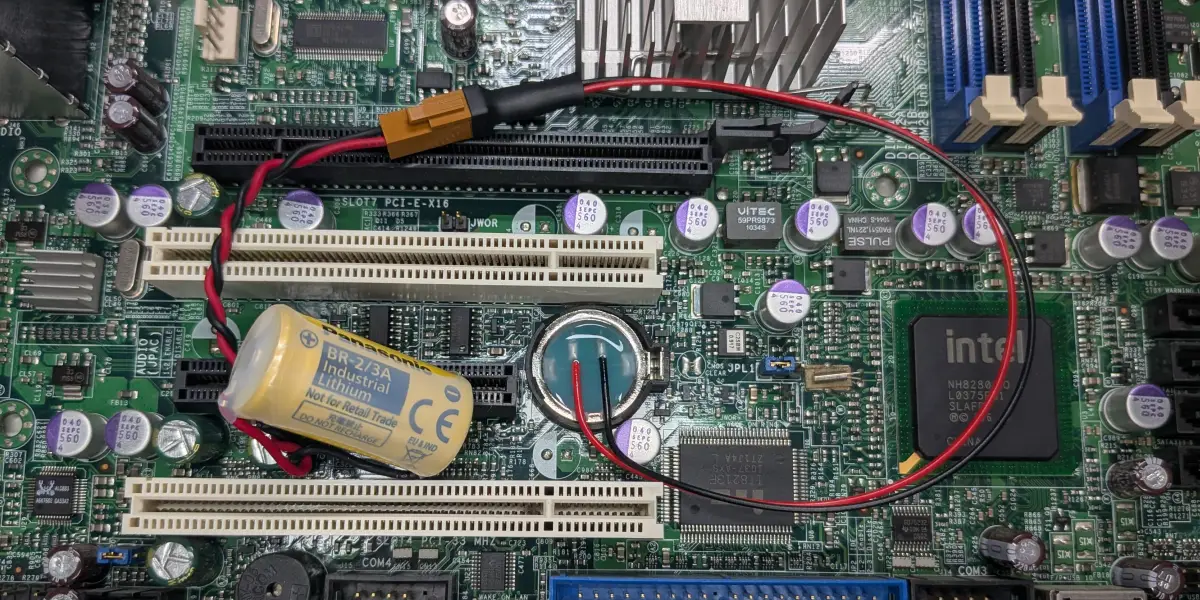
The basic configuration would be:
CR2032 Holder
↓
Dummy Coin Cell
↓
Cable
↓
External 3 V Backup Battery
This makes it possible to bring the backup power connection outside the CPU board without soldering or otherwise modifying the board itself.
For example, using a 3 V BR-2/3A provides a higher capacity than a CR2032 and makes it possible to consider a power configuration designed with long-term backup in mind.
Externalizing the battery also provides another benefit that is separate from simply increasing its capacity.
If the battery is installed in an easily accessible location within the equipment, there is no need to access the CPU board the next time the battery needs to be replaced.
In other words, maintainability can be improved in two ways at the same time:
“Reduce how often the battery needs to be replaced.”
and
“Make the next battery replacement easier.”
Considerations When Using an External Battery
Although the CR2032 and BR-2/3A are both 3 V nominal primary lithium batteries, the BR-2/3A has a different capacity and physical form factor.
Actual implementation therefore requires appropriate safety considerations, including correct polarity and wiring, secure battery mounting, proper cable routing, and protection against short circuits.
Because this also represents a modification to existing equipment, the manufacturer’s warranty and maintenance requirements should be checked before implementation.
For Equipment Expected to Last 10 Years, Even Small Consumable Components Deserve Attention
Industrial PCs, machine vision systems, and measurement equipment may remain in service for more than 10 years.
At the same time, they may contain consumable components such as RTC backup batteries.
As in the example discussed earlier, equipment that operates for nine hours on weekdays and is powered off at night and throughout the weekend has its main power turned off for approximately 73% of each week.
If the RTC is designed to rely on the backup battery while the main power is off, this also means that the backup battery must operate for a significant amount of time.
Another challenge is that it can be difficult for equipment manufacturers and distributors to continuously monitor the remaining capacity of RTC backup batteries after the equipment has been delivered.
It is possible that the first indication of battery depletion comes only after receiving reports such as:
“The clock is incorrect.”
“The settings changed after the equipment was powered off and back on.”
“The equipment is behaving differently than usual.”
Only after investigating the problem may the depleted backup battery be identified as the cause.
Even if the root cause is a battery that costs only a few dollars, the total effort can be significant once it involves customer support, troubleshooting, communication between the distributor and manufacturer, arranging service personnel, an on-site visit, battery replacement, and configuration checks.
For industrial equipment expected to remain in service for more than 10 years, it may therefore be worth considering not only:
“How many years should the RTC backup battery last?”
but also:
“Can we reduce how often it needs to be replaced?”
“Can we make it easier to access when replacement is eventually required?”
These questions can be considered as part of the overall maintenance design of the equipment.
If you’re using an industrial PC for 10 years, the RTC backup battery should last 10 years too.
Increasing the capacity of the RTC backup battery or relocating it outside the CPU board are two possible approaches toward achieving that goal.
Cyack Lab develops and sells dummy coin cells designed to bring power connections outside coin-cell holders such as those designed for CR2032 batteries.
By allowing the backup power connection to be brought outside the CPU board without modifying the board itself, these dummy coin cells can be used for applications such as externalizing the RTC backup battery or relocating it to a more accessible position for easier replacement.
If your equipment is expected to remain in service for 10 years, it may be worth taking another look at the small backup battery inside it.